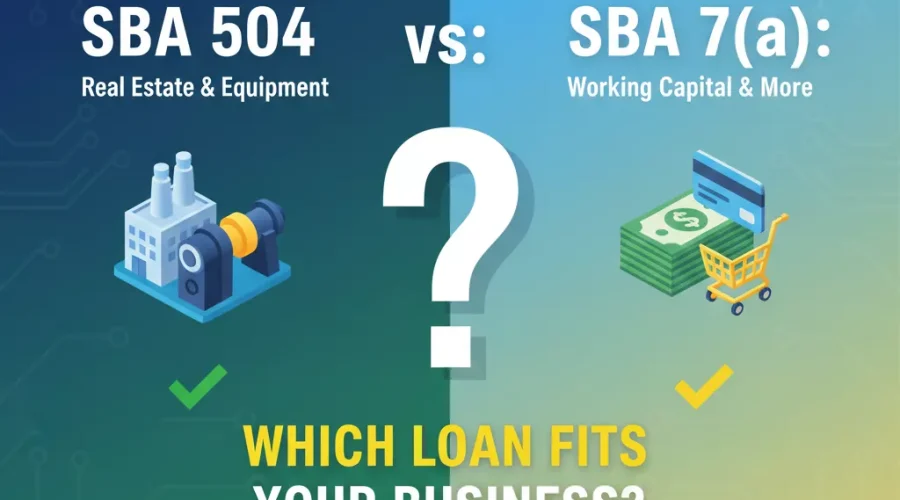
Choosing between an SBA 504 loan and an SBA 7(a) loan can feel like deciphering a financial puzzle. Both are backed by the Small Business Administration and offer incredible benefits to US business owners, but they serve distinctly different purposes and come with their own sets of rules.
If you’re a local business owner or professional looking to expand your operations, purchase real estate, or simply need capital to grow, understanding these two loan programs is essential. The wrong choice could mean paying more in interest, facing restrictions on how you use the funds, or even getting denied altogether.
The main difference between SBA 504 and 7(a) loans is their purpose: 504 loans are specifically for purchasing fixed assets like real estate and heavy equipment with lower down payments (10%), while 7(a) loans offer more flexibility for working capital, inventory, refinancing, and various business expenses. SBA 504 loans typically have lower interest rates but stricter use requirements, whereas 7(a) loans provide broader usage options with slightly higher rates and require 10-20% down payment.
What Is an SBA 504 Loan?
An SBA 504 loan is a long-term, fixed-rate financing option designed specifically for purchasing major fixed assets like commercial real estate, buildings, or heavy equipment. It’s structured as a three-party loan involving a lender, a Certified Development Company (CDC), and the borrower.
The SBA 504 program exists to help small businesses acquire the physical assets they need to grow while keeping down payments low and interest rates competitive. Unlike conventional commercial loans, the 504 loan splits financing between a traditional lender (covering 50% of the project), a CDC backed by the SBA (covering 40%), and the borrower’s down payment (just 10% in most cases).
This structure makes it particularly attractive for businesses that want to:
- Purchase owner-occupied commercial real estate
- Build new facilities or renovate existing ones
- Buy large equipment with a useful life of at least 10 years
The fixed interest rates are tied to the current market rate on 5-year and 10-year US Treasury issues, plus a small markup, making them historically lower than many conventional options. However, the trade-off is strict usage requirements—you can’t use 504 funds for working capital, inventory, or debt refinancing.
According to the SBA’s official 504 loans page, these loans have helped thousands of American businesses invest in their long-term growth through property and equipment acquisition.
Key Differences Between 504 and 7(a) Loans
Let’s cut through the complexity with a straightforward comparison:
Loan Amount
- 504 Loan: CDC portion up to $5 million (standard) or $5.5 million for manufacturing or energy-related projects
- 7(a) Loan: Up to $5 million total
Down Payment
- 504 Loan: Typically 10% (can be 15-20% for special-purpose properties or newer businesses)
- 7(a) Loan: 10-20% depending on loan purpose and borrower qualifications
Primary Use
- 504 Loan: Fixed assets only—real estate and equipment
- 7(a) Loan: Broad usage including working capital, inventory, debt refinancing, and acquisitions
Interest Rate Structure
- 504 Loan: Fixed rates tied to Treasury rates, historically lower
- 7(a) Loan: Variable or fixed, typically prime + 2.25% to 4.75%
Loan Term
- 504 Loan: 10, 20, or 25 years depending on asset type
- 7(a) Loan: Up to 10 years for equipment/working capital, up to 25 years for real estate
Structure
- 504 Loan: Three-party structure (lender, CDC, borrower)
- 7(a) Loan: Two-party structure (lender and borrower, with SBA guarantee)
Job Creation Requirement
- 504 Loan: Must create or retain one job per $65,000 of SBA funding (or meet public policy goals)
- 7(a) Loan: No specific job creation requirement
Eligibility Requirements Comparison
Both loan programs have baseline SBA eligibility requirements, but there are important distinctions:
SBA 504 Loan Eligibility
To qualify for a 504 loan, your business must:
- Operate as a for-profit entity in the United States
- Have a tangible net worth below $15 million
- Have an average net income under $5 million (after taxes) for the preceding two years
- Occupy at least 51% of an existing building or at least 60% of a new construction project
- Demonstrate the ability to repay the loan from business cash flow
- Meet job creation or public policy goals (typically 1 job per $65,000 borrowed)
Important note: Certain business types are ineligible, including passive real estate holding companies, lending institutions, and businesses primarily engaged in speculation.
SBA 7(a) Loan Eligibility
Requirements for 7(a) loans include:
- Operating as a for-profit business in the US or its territories
- Meeting SBA size standards (varies by industry, generally under 500 employees)
- Demonstrating a need for the financing and inability to get funds elsewhere on reasonable terms
- Having invested equity in the business (the “skin in the game” requirement)
- Being current on all existing debt obligations
- Having acceptable credit history and demonstrating good character
The 7(a) program is generally more accessible to startups and businesses with less operating history, though they’ll face more scrutiny on their business plan and projections.
Interest Rates and Terms
Understanding the cost of borrowing is critical when choosing between these programs.
504 Loan Rates and Terms
SBA 504 loans feature fixed interest rates that are remarkably stable. The CDC portion of the loan (the 40% backed by the SBA) uses rates that are set monthly and tied to 5-year and 10-year Treasury rates plus a small spread (typically 2.3% to 2.7% above the Treasury rate).
As of late 2024, effective 504 rates have ranged from approximately 5.5% to 6.5%, though these fluctuate with market conditions. The lender’s portion (the first 50%) will have its own terms set by the bank, usually slightly higher but still competitive.
Loan terms:
- 10 years for equipment and machinery
- 20 years for real estate with significant renovations
- 25 years for new construction or land purchase with building
There are minimal or no balloon payments, and the fixed-rate structure protects you from interest rate volatility over the life of the loan.
7(a) Loan Rates and Terms
Interest rates on 7(a) loans are generally higher and can be either fixed or variable. The SBA sets maximum allowable rates based on the prime rate:
- Loans $50,000 or more: Prime + up to 2.75% (fixed) or Prime + up to 4.75% (variable)
- Loans under $50,000: Prime + up to 3.5% (fixed) or Prime + up to 5.5% (variable)
Most lenders price 7(a) loans somewhere in the middle of these ranges based on creditworthiness and collateral.
Loan terms:
- Up to 10 years for working capital and equipment
- Up to 25 years for real estate purchases
The flexibility in rate structure means you can sometimes lock in fixed rates if you’re concerned about rising interest environments, or opt for variable rates when the prime rate is favorable.
Want to calculate your potential monthly payments? Check out our SBA 504 Loan Calculator to run the numbers for your specific scenario.
Best Use Cases for Each Loan Type
Choosing the right loan often comes down to what you need the money for. Here’s when each program shines:
When to Choose an SBA 504 Loan
Scenario 1: Purchasing Commercial Real Estate
You’re a growing retail business ready to stop leasing and buy your storefront. The 504 loan’s low 10% down payment and fixed rates make it ideal for locking in long-term real estate costs.
Scenario 2: Building a New Facility
A manufacturing company needs to construct a 15,000 square-foot production facility. The 504 program’s 25-year terms and job creation alignment make this a perfect fit.
Scenario 3: Major Equipment Investment
A medical practice needs to purchase expensive diagnostic equipment with a 15-year useful life. The 504’s fixed rates and extended terms reduce monthly payment burdens.
Bottom line: Choose 504 when you’re making a large, long-term fixed asset investment and want the lowest possible rates and down payment.
When to Choose an SBA 7(a) Loan
Scenario 1: Working Capital Needs
A seasonal business needs $200,000 to cover operating expenses during slow months and stock up on inventory before peak season. Only 7(a) allows this.
Scenario 2: Business Acquisition
You’re buying an established local business for $500,000. The 7(a) program is specifically designed to help with business purchases, while 504 cannot be used for this purpose.
Scenario 3: Debt Refinancing
A restaurant has high-interest debt from credit lines and wants to consolidate into one lower-rate SBA loan with better terms. The 7(a) refinancing option makes this possible.
Scenario 4: Mixed-Use Purchases
You need $300,000 for a combination of equipment, initial inventory, and working capital. The 7(a) loan’s flexibility covers all these bases in one package.
Bottom line: Choose 7(a) when you need versatility, are covering multiple business needs, or require working capital and operational funding.
Pros and Cons: SBA 504 Loan vs SBA 7(a) Loan
| Feature | SBA 504 Loan | SBA 7(a) Loan |
|---|---|---|
| Primary Use | Fixed assets like real estate, buildings, and equipment | Almost any legitimate business purpose |
| Down Payment | Lower, typically around 10 percent | Higher, usually 10 to 20 percent |
| Interest Rates | Fixed rates for 10 to 25 years | Often variable, can increase over time |
| Overall Cost | Generally, 0.5 to 1 percent lower than 7(a) loans | Usually higher than 504 loans |
| Repayment Terms | Long terms reduce monthly payments | Shorter terms for working capital |
| Balloon Payments | No balloon payments, fully amortized | Some loans may include balloon payments |
| Usage Flexibility | Restricted to fixed asset purchases | Very flexible use of funds |
| Job Creation Requirement | Must create or retain jobs or meet public policy goals | No job creation requirement |
| Loan Structure | Three-party structure with lender, CDC, and SBA | Two-party structure with lender and SBA |
| Processing Time | Longer closing time, typically 60 to 90 days | Faster approval, often 30 to 60 days |
| Owner Occupancy | Requires 51 to 60 percent owner occupancy | No owner occupancy requirement |
| Startup Friendly | Better suited for established businesses | More accessible to startups |
| Collateral and Guarantees | Less personal collateral required in many cases | Often requires personal guarantees and collateral |
Application Process: What to Expect
Both loan programs require substantial documentation and preparation. Here’s what you need to know:
General Documentation Required (Both Programs)
- Personal and business tax returns (typically 3 years)
- Personal financial statements from all owners with 20%+ stake
- Business financial statements (balance sheet, P&L, cash flow projections)
- Business plan or expansion plan
- Articles of incorporation and business licenses
- Resume or business background of owners/principals
- Purchase agreement (if buying property or business)
- Detailed use of proceeds statement
504-Specific Process
- Find a CDC: Locate a Certified Development Company in your area
- Identify a lender: Secure the first lien lender (bank/credit union)
- Submit applications: Complete applications with both CDC and lender
- SBA review: CDC packages your application for SBA approval
- Closing: Typically 60-90 days from complete application
- Ongoing requirements: May need to provide job creation updates
7(a)-Specific Process
- Choose an SBA-approved lender: Find a bank experienced with 7(a) loans
- Submit application: Complete lender’s application package
- Lender review: Bank underwrites and decides whether to request SBA guarantee
- SBA authorization: If needed, lender submits to SBA for guarantee approval
- Closing: Typically 30-60 days for standard processing
- Disbursement: Funds released according to loan agreement terms
Pro tip: Working with an SBA Preferred Lender (PLP) on 7(a) loans can significantly speed up approval since they have delegated authority to approve loans without sending each one to the SBA.
Which Loan Should You Choose?
Here’s a practical decision framework:
Choose SBA 504 if:
- ✅ You’re purchasing or refinancing owner-occupied real estate
- ✅ You need to buy major equipment with 10+ year useful life
- ✅ You want the absolute lowest rates and down payment
- ✅ You can meet job creation requirements
- ✅ You don’t need working capital or operational funding
Choose SBA 7(a) if:
- ✅ You need working capital or inventory funding
- ✅ You’re buying an existing business
- ✅ You want to refinance existing debt
- ✅ You need flexibility in how funds are used
- ✅ You’re a startup with limited operating history
- ✅ You need faster approval and funding
Still not sure? Many businesses actually use both programs strategically. For example, you might use a 504 loan to purchase your building and equipment, then later secure a 7(a) loan for working capital or a seasonal line of credit. They’re not mutually exclusive—they’re complementary tools in your financing toolkit.
FAQs
Can I have both a 504 and 7(a) loan at the same time?
Yes. Many businesses use an SBA 504 loan for real estate or large equipment and an SBA 7(a) loan for working capital or operational expenses. The SBA allows both, as long as total exposure limits are met.
Which SBA loan is easier to qualify for?
The SBA 7(a) loan is generally easier to qualify for, especially for newer businesses. SBA 504 loans have stricter requirements, including owner occupancy and job creation rules.
Can I use a 504 loan to buy a building and rent part of it out?
Yes. You must occupy at least 51 percent of an existing building or 60 percent of new construction. Any remaining space can be rented to tenants, which can help offset loan payments.
Are there prepayment penalties on SBA loans?
SBA 504 loans usually have prepayment penalties on the CDC portion during the early years. SBA 7(a) loans with terms over 15 years may have prepayment penalties in the first three years, while shorter terms typically do not.
What credit score do I need for an SBA loan?
Most lenders prefer a personal credit score of 680 or higher. Scores above 700 improve approval chances and loan terms, but lower scores may still qualify with strong financials.
How long does it take to get SBA loan funding?
SBA 504 loans usually take 60 to 90 days due to their multi-party structure. SBA 7(a) loans often close faster, typically within 30 to 60 days.
Conclusion
The choice between an SBA 504 loan and an SBA 7(a) loan isn’t about which one is “better”; it’s about which one aligns with your specific business needs, growth plans, and financial situation.
Before you apply, take time to:
- Gather your financial documentation
- Run the numbers using tools like Toolstecique SBA 504 Loan Calculator
- Connect with multiple SBA-approved lenders to compare offers
- Consider working with a loan broker or consultant who specializes in SBA financing
The right financing can be transformational for your business. Both the 504 and 7(a) programs exist to help American small businesses access affordable capital. Choose the one that sets you up for long-term success.
To improve your overall financial strategy, consider using tools like a budget calculator to track monthly income and expenses, a debt repayment calculator to plan faster payoff strategies, and a loan amortization calculator to understand how interest impacts your payments over time.