











|
Interest is everywhere in your financial life, on your savings account, your mortgage, your credit card, and your investments. But most people never stop to ask a critical question: Is this simple or compound interest? Because the answer changes everything about how fast your money grows, or how quickly your debt spirals.
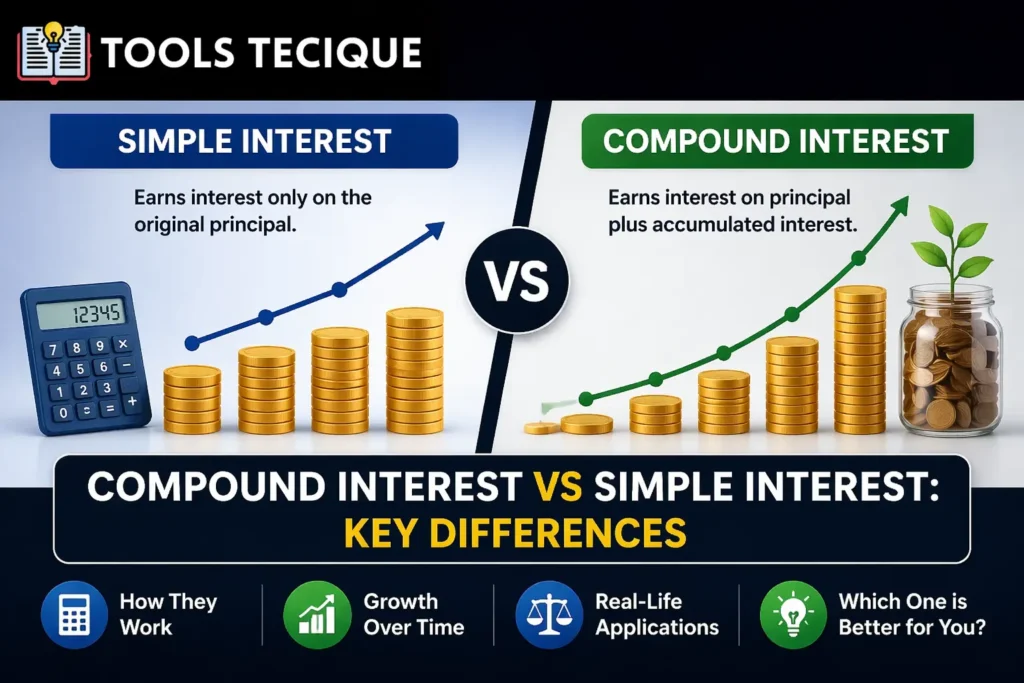
The difference between the two is straightforward once you see it side by side. Simple interest is predictable and linear; it grows steadily year after year. Compound interest is exponential — it starts slow, then accelerates. Over 10, 20, or 30 years, the gap becomes enormous.
This guide breaks down both types with plain-English explanations, clear formulas, real worked examples at different time horizons, and a look at exactly when each type works for you or against you. Use the free Compound Interest Calculator to model your own numbers after reading.
What Is Simple Interest?
Simple interest is calculated only on the original amount you deposited or borrowed, called the principal. Every period, you earn (or owe) exactly the same fixed amount of interest. It never grows. It never compounds. It’s completely predictable.
| Simple Interest Formula I = P × r × t
I = Interest earned or owed P = Principal (starting amount) r = Annual interest rate (as a decimal, e.g. 5% = 0.05) t = Time in years |
Simple Interest Example
You deposit $5,000 in a savings account paying 6% simple interest per year for 5 years.
I = $5,000 × 0.06 × 5 = $1,500 in interest
Total after 5 years: $5,000 + $1,500 = $6,500
Notice: you earn exactly $300 every single year, year after year. The interest amount never changes because it’s always calculated on the original $5,000 — not on your growing balance.
Where You’ll Find Simple Interest in Real Life
- Car loans and personal loans
- Most mortgages (interest calculated on the outstanding principal balance)
- Student loans
- Some short-term business loans
- US Treasury bonds and bills
What Is Compound Interest?
Compound interest is calculated on your principal plus all the interest you’ve already earned. Each period, your interest is added to your balance, and that larger balance becomes the new base for the next period’s calculation. This is “interest on interest”, and over time, it creates exponential growth.
Albert Einstein allegedly called compound interest the “eighth wonder of the world.” Whether or not he actually said it, the math backs it up: compounding turns even modest returns into substantial wealth if given enough time. [realbricks]
| Compound Interest Formula A = P × (1 + r/n)^(n × t)
A = Final amount (principal + interest) P = Principal (starting amount) r = Annual interest rate (as a decimal) n = Number of times interest compounds per year t = Time in years
Common compounding frequencies: Annually (n=1) | Quarterly (n=4) | Monthly (n=12) | Daily (n=365) |
Compound Interest Example
You deposit $5,000 at 6% interest compounded monthly for 5 years.
A = $5,000 × (1 + 0.06/12)^(12×5) = $5,000 × (1.005)^60 = $6,744.25
Interest earned: $6,744.25 − $5,000 = $1,744.25
Compared to simple interest’s $1,500, compound interest earned $244.25 more on the exact same deposit, rate, and time period. That gap keeps widening the longer the money sits.
Simple vs Compound Interest: Side-by-Side Comparison
| Simple Interest | Compound Interest | |
| Calculated on | Principal only | Principal + accumulated interest |
| Growth pattern | Linear (steady, flat growth) | Exponential (slow start, then accelerates) |
| Formula | I = P × r × t | A = P(1 + r/n)^(nt) |
| Better for borrowers? | Yes — cheaper, more predictable | No — debt grows faster |
| Better for investors? | No — slower wealth accumulation | Yes — ‘interest on interest’ accelerates growth |
| Common examples | Car loans, mortgages, personal loans | Savings accounts, credit cards, investments |
| Predictability | Fully predictable | Depends on compounding frequency |
The Real Difference Over Time: $5,000 at 6% for 1 to 30 Years
Here’s where the two types of interest truly diverge. The longer the time horizon, the more dramatic the difference. This table uses $5,000 at 6% interest for both methods to show exactly what happens over time.
| Time Period | Simple Interest (Total) | Compound Monthly (Total) | Difference |
| 1 year | $5,300.00 | $5,308.39 | +$8.39 |
| 3 years | $5,900.00 | $6,046.55 | +$146.55 |
| 5 years | $6,500.00 | $6,744.25 | +$244.25 |
| 10 years | $8,000.00 | $9,096.98 | +$1,096.98 |
| 20 years | $11,000.00 | $16,551.02 | +$5,551.02 |
| 30 years | $14,000.00 | $30,153.52 | +$16,153.52 |
At 5 years, the difference is modest. At 10 years, it’s noticeable. By 30 years, compound interest has produced more than double what simple interest generated — from the exact same $5,000 deposit at the exact same 6% rate. Time is the compound investor’s greatest asset.
Want to run these numbers with your own principal, rate, and timeline? The free Compound Interest Calculator on ToolsTecique lets you model any scenario instantly.
Does Compounding Frequency Matter?
Yes — and more than most people realise. The more often interest compounds, the more total interest you earn (as an investor) or owe (as a borrower). Here’s the same $5,000 at 6% for 10 years under different compounding frequencies:
| Compounding Frequency | Times per Year (n) | Balance After 10 Years | Interest Earned |
| Annually | 1 | $8,954.24 | $3,954.24 |
| Quarterly | 4 | $9,070.09 | $4,070.09 |
| Monthly | 12 | $9,096.98 | $4,096.98 |
| Daily | 365 | $9,110.14 | $4,110.14 |
The difference between annual and daily compounding on this example is about $156 over 10 years — meaningful, but not earth-shattering on a $5,000 deposit. On a $500,000 retirement account, that same frequency difference compounds into $15,000+. At scale, frequency matters significantly. Always check how often your savings account or investment account compounds.
When Compound Interest Works Against You
Compound interest is your best friend as an investor and your worst enemy as a borrower. The same “interest on interest” effect that builds wealth in a retirement account can rapidly spiral debt out of control when it works against you.
Credit Card Debt: Daily Compounding at High Rates
Most credit cards compound interest daily on your outstanding balance. At a typical APR of 22%, a $5,000 balance left unpaid for 3 years grows to over $10,000 even if you never spend another cent on the card. The compounding frequency, combined with a high interest rate, is what makes credit card debt so dangerous.
Student Loans During Deferment
Many student loans accrue interest even while you’re not making payments during deferment or grace periods. If that interest isn’t paid, it capitalises, meaning it gets added to your principal. Now you’re paying interest on a larger balance. This is compound interest working against you in slow motion.
The Rule of 72 Connection
Remember the Rule of 72 from our earlier guide? At 22% interest (typical credit card APR), your balance doubles in just 72 ÷ 22 = 3.3 years. That’s the power of compounding working against you. See the full breakdown in our Rule of 72 guide.
Which Is Better — Simple or Compound Interest?
The honest answer: it depends entirely on which side of the equation you’re on.
| Situation | Which Is Better for You? | Why |
| Taking out a loan | Simple interest | You pay less overall — no interest-on-interest spiral |
| Opening a savings account | Compound interest | Your money grows faster as interest builds on itself |
| Investing long-term | Compound interest | Decades of compounding creates exponential wealth growth |
| Carrying credit card debt | Simple interest | Compound interest on credit cards is expensive and fast-growing |
| Short-term deposit (< 1yr) | Similar either way | Compounding impact is minimal over very short periods |
As a general rule, seek compound interest on your investments and savings, avoid it on your debt. Pay off high-interest compound debt aggressively, use the Debt Repayment Calculator to build your plan — while simultaneously building compound growth in your savings and investments.
Frequently Asked Questions
1. Is APR simple interest, and APY compound interest?
APR (Annual Percentage Rate) is generally used for loans and represents the yearly cost of borrowing without compounding. APY (Annual Percentage Yield), on the other hand, includes compounding effects and is commonly used for savings and investments.
🔹 APY is always equal to or higher than APR for the same stated interest rate.
🔹 Compare APY for savings accounts and APR for loans. Always compare like with like.
2. Can simple interest become compound interest over time?
No, simple and compound interest are distinct calculation methods defined by your account or loan terms.
- Simple interest remains simple throughout the product’s life.
- However, if you reinvest the interest earned, you can manually create a compounding effect by increasing your principal.
3. Why does starting early matter for compound interest?
Compound interest grows exponentially, not linearly, so time is critical.
- Initial years (e.g., 0–10) produce modest growth.
- Later years (e.g., 20–30) produce dramatic gains.
- Example: Investing $10,000 at age 25 will yield significantly more by age 65 than investing the same amount at 35 — despite the same rate.
4. Do savings accounts use simple or compound interest?
Most savings accounts use compound interest, usually daily or monthly. This is why the APY is slightly higher than the stated interest rate, reflecting compounding over a year. High-yield savings accounts (HYSA) and money market accounts compound daily, which accelerates growth compared to standard accounts with similar rates.