










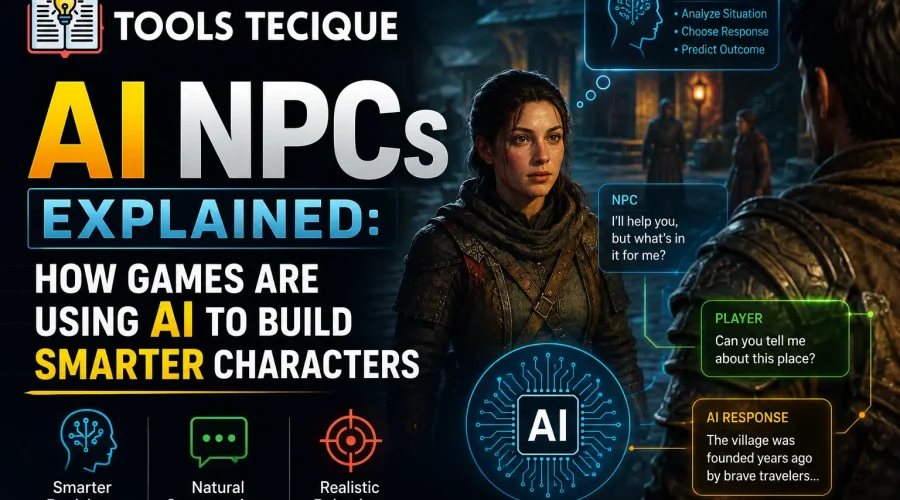
Les PNJ gérés par l'IA sont des personnages non-joueurs pilotés par des modèles d'IA capables de générer des dialogues et des comportements dynamiques et contextuels, au lieu de se baser sur des lignes de dialogue pré-écrites. Cela permet aux jeux de réagir plus naturellement aux choix du joueur, même si la plupart des implémentations actuelles combinent encore des éléments générés par l'IA avec des systèmes scriptés traditionnels, plutôt que de reposer entièrement sur une génération d'IA en temps réel.
Les personnages non-joueurs ont longtemps été l'une des illusions les plus flagrantes du jeu vidéo : quelques répliques préétablies répétées en boucle, peu importe le nombre de fois où on leur parle. L'IA commence à véritablement changer la donne, permettant aux personnages de réagir aux paroles et aux actions du joueur plutôt qu'à un scénario prédéfini.
Selon Développeur de jeux Concernant la couverture médiatique de l'adoption de l'IA dans les studios, plusieurs grands éditeurs ont commencé à expérimenter des systèmes de dialogue avec des PNJ pilotés par l'IA dans leurs jeux commercialisés, bien que son adoption généralisée dans l'ensemble du secteur reste à un stade relativement précoce par rapport à d'autres applications de l'IA dans le développement de jeux. La plateforme ACE de Nvidia est l'un des exemples les plus visibles de cette évolution, fournissant des outils spécifiquement conçus pour donner aux studios de jeux un cadre permettant de générer des dialogues PNJ en temps réel plutôt que d'exiger de chaque studio qu'il construise l'infrastructure d'IA sous-jacente à partir de zéro.
Comment fonctionnent réellement les PNJ IA ?
Les PNJ contrôlés par l'IA utilisent des modèles de langage pour générer des dialogues et parfois des comportements de manière dynamique en fonction du contexte de jeu et des actions du joueur, plutôt que de se baser sur un ensemble fixe de répliques pré-écrites. La plupart des implémentations contraignent néanmoins l'IA selon des règles définies par les scénaristes du jeu afin de garantir la cohérence des réponses avec le personnage et l'histoire.
Le défi technique ne consiste pas seulement à générer des dialogues plausibles ; il s'agit de maintenir la cohérence de ces dialogues avec la personnalité établie des personnages et la continuité de l'histoire tout au long du jeu, ce qui explique pourquoi la plupart des systèmes actuels combinent la génération par IA avec une structure scriptée traditionnelle plutôt qu'une génération totalement ouverte.
D'après notre expérience : un studio de développement de jeux vidéo, testant un système de PNJ piloté par IA pour un petit titre indépendant, a constaté que des dialogues d'IA totalement libres produisaient des réponses souvent techniquement cohérentes, mais incohérentes avec les personnages, les PNJ contredisant parfois des éléments établis de l'histoire. L'ajout d'une couche de contexte structurée, fournissant à l'IA un résumé de l'état pertinent de l'histoire et des traits de personnalité des personnages avant de générer chaque réponse, a corrigé la plupart de ces incohérences. Ceci démontre que les systèmes de PNJ IA nécessitent un encadrement précis plutôt qu'une totale liberté.
PNJ IA vs PNJ scriptés traditionnels
| Aspect | Écriture traditionnelle | Piloté par l'IA |
|---|---|---|
| variété de dialogue | Ensemble fixe de réponses | Généré dynamiquement |
| Cohérence | Entièrement contrôlé par les écrivains | Nécessite des garde-fous soignés |
| coût de développement | Haut pour un dialogue approfondi | Structure de coûts différente |
| Rejouabilité | Les mêmes lignes à chaque fois | Varie selon la partie |
Point clé à retenir : Les PNJ IA ne sont pas simplement « meilleurs » que les personnages scriptés traditionnels, ils échangent la prévisibilité et le contrôle narratif précis des dialogues scriptés contre une réactivité dynamique, qui convient bien mieux à certains genres de jeux qu'à d'autres.
Quels types de jeux tirent le plus profit des PNJ IA ?
- Jeux en monde ouvert et de type bac à sable Profitez des PNJ capables de réagir naturellement aux comportements imprévisibles des joueurs.
- Jeux de simulation sociale Tirer profit de personnages capables de tenir des conversations plus naturelles et variées au fil d'interactions répétées.
- Jeux narratifs à l'intrigue serrée Ils en tirent souvent moins profit, car des dialogues précis et scénarisés servent mieux des moments clés d'une histoire soigneusement élaborée.
D'après mon expérience : un concepteur de jeu travaillant sur un jeu de simulation agricole et de vie était enthousiaste à l'idée d'intégrer des PNJ contrôlés par l'IA, mais les a initialement implémentés sans aucune limite, permettant aux villageois de discuter librement de n'importe quel sujet. Les tests ont révélé que cela nuisait à l'immersion lorsque les personnages abordaient des sujets du monde réel sans aucun rapport avec l'univers du jeu. Limiter l'IA aux seuls sujets pertinents pour le monde du jeu et les personnages établis a résolu le problème d'immersion tout en préservant une variété de dialogues bien plus importante que celle offerte par la version précédente entièrement scriptée.
Compromis entre performances et matériel
L'exécution en direct de la génération d'IA, que ce soit localement sur l'appareil du joueur ou via une connexion cloud, engendre une surcharge de calcul que les dialogues scriptés traditionnels n'ont tout simplement pas. Les studios développant des systèmes d'IA pour les PNJ doivent choisir entre l'inférence locale, qui évite la latence et la dépendance à la connexion mais sollicite davantage le matériel du joueur, et la génération dans le cloud, qui décharge le système de cette charge de calcul mais introduit une dépendance à la connectivité internet et une latence de réponse susceptible de nuire à l'immersion lors des phases de jeu rapides.
Ce compromis explique en grande partie pourquoi les PNJ IA sont jusqu'à présent apparus principalement dans des genres plus lents comme les simulations de vie et les aventures narratives, où une brève pause pour la génération de dialogues est beaucoup moins perturbatrice que dans un jeu de tir ou de combat à réaction rapide.
Préoccupations courantes concernant les PNJ IA
- Ruptures de cohérence, où les dialogues générés par l'IA contredisent les faits établis de l'histoire ou des personnages sans garde-fous suffisants.
- Augmentation des coûts de calcul par rapport au simple chargement de texte pré-écrit, ce qui affecte les performances, notamment sur du matériel bas de gamme.
- Défis liés à la modération de contenu, car les dialogues générés dynamiquement nécessitent des mesures de protection pour empêcher tout contenu inapproprié.
Foire aux questions
Q : Les PNJ contrôlés par l'IA remplacent-ils complètement les dialogues scriptés dans les jeux ?
R : Pas actuellement. La plupart des jeux utilisant des PNJ IA combinent des éléments générés par l'IA avec une structure scriptée traditionnelle pour les moments clés de l'histoire, plutôt que de s'appuyer entièrement sur une génération d'IA en direct tout au long du jeu.
Q : Les PNJ IA ont-ils besoin d'une connexion internet pour fonctionner ?
R : Cela dépend de l'implémentation. Certains systèmes d'IA pour PNJ utilisent des modèles de langage basés sur le cloud nécessitant une connexion internet, tandis que d'autres utilisent des modèles plus petits, exécutés localement, qui peuvent fonctionner hors ligne, mais généralement avec un résultat moins sophistiqué.
Q : Les PNJ contrôlés par l'IA peuvent-ils se souvenir des conversations précédentes avec le joueur ?
A: Certaines implémentations incluent des systèmes de mémoire qui permettent aux PNJ de se référer aux interactions passées, créant ainsi une expérience plus personnalisée, bien que cela ajoute une complexité technique et ne soit pas encore standard dans toutes les implémentations de PNJ IA.
Q : Les PNJ dotés d'une IA rendent-ils les jeux plus coûteux à développer ?
A : Les coûts de développement se déplacent plutôt qu'ils n'augmentent simplement, car moins de temps peut être consacré à l'écriture d'arbres de dialogue exhaustifs, mais davantage à la construction et au test des garde-fous et des mécanismes de cohérence du système d'IA.
Q : Les PNJ dotés d'une IA rendront-ils les jeux moins personnalisés et plus génériques ?
A : Il s'agit d'un véritable problème de conception dans l'industrie, c'est pourquoi la plupart des implémentations réussies maintiennent les PNJ IA dans des limites soigneusement définies plutôt que de permettre une génération totalement ouverte qui pourrait s'éloigner de l'expérience de jeu prévue.
Explorez davantage de guides de jeux
ToolsTecique explique comment l'IA va redéfinir la conception des jeux et l'expérience des joueurs en 2026. Notre guide sur ce qu'est réellement l'IA agentique Il aborde la tendance technologique plus large qui sous-tend bon nombre de ces nouveaux systèmes de jeu basés sur l'IA, et notre guide sur Le cloud gaming en 2026 Cet article aborde également le compromis de latence auquel les studios sont confrontés lorsqu'ils décident d'exécuter la génération d'IA localement ou via le cloud.
