










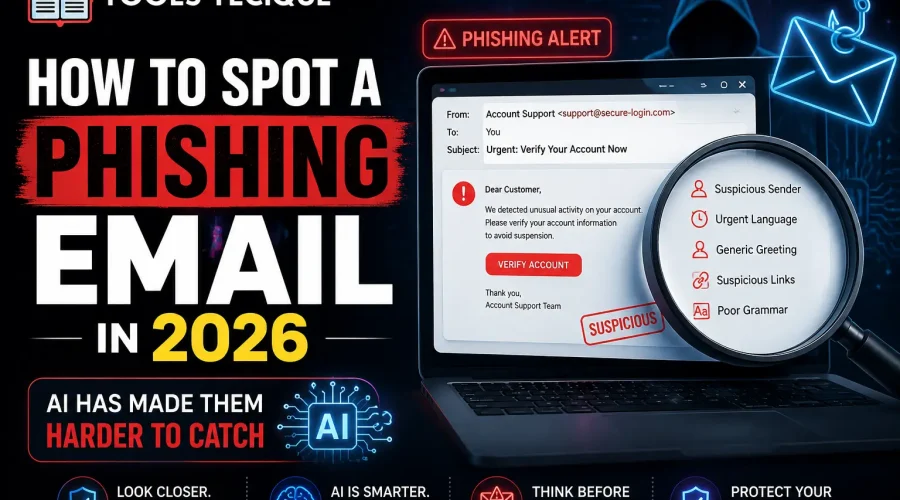
Modern phishing emails are harder to spot because AI tools help scammers write grammatically perfect, personalized messages that mimic legitimate companies convincingly. Warning signs still include urgent or threatening language, requests to click links or verify account details, mismatched sender email addresses, and unexpected attachments, even when the writing quality itself no longer gives it away.
Phishing emails used to be easy to spot: broken English, obvious formatting errors, and generic greetings gave them away instantly. AI writing tools have quietly erased that advantage, producing phishing emails that read as cleanly as a legitimate company’s actual communication.
وفق CISA’s phishing guidance, attackers increasingly use AI tools to craft more convincing, personalized phishing content, making traditional advice to watch for spelling and grammar errors significantly less reliable than it once was.
How Has AI Changed Phishing Emails?
AI writing tools let scammers produce phishing emails with perfect grammar, professional tone, and personalized details pulled from public information like social media or company websites. This eliminates the grammatical red flags that used to be a primary way people identified phishing attempts, shifting the focus to behavioral and technical warning signs instead.
Personalization is the more concerning shift. AI can quickly incorporate a target’s name, employer, or recent public activity into a phishing message, making it feel far more credible than a generic mass email ever could.
From experience: A finance department employee received an email that appeared to come from her company’s CEO, referencing a real, recently announced acquisition and requesting an urgent wire transfer to close the deal. The email was grammatically flawless and used accurate internal terminology, both signs of AI-assisted crafting. She followed her company’s standing policy of verifying any wire transfer request through a separate phone call, which the CEO’s real assistant confirmed had never been sent, preventing what would have been a significant financial loss.
Phishing Warning Signs That Still Work
| Warning Sign | Why It Still Works |
|---|---|
| Urgency and pressure | Designed to bypass careful review |
| Mismatched sender address | Harder to fake convincingly |
| Unusual payment requests | Deviates from normal process |
| Unexpected attachments or links | Still a common delivery method |
الخلاصة الرئيسية: Since writing quality is no longer a reliable indicator, verifying requests through a separate communication channel has become the single most effective defense against modern phishing attempts.
How to Protect Yourself From AI-Enhanced Phishing
- Verify unusual requests through a separate channel, such as a phone call to a known number, rather than replying to the email directly.
- Check the actual sender email address, not just the displayed name, since attackers often use addresses that look similar but are not identical to the real domain.
- Hover over links before clicking to see the actual destination URL, which often reveals a mismatch with the claimed sender.
- Be especially cautious with financial requests, even ones that appear to come from known contacts or executives.
- Report suspicious emails to your IT department or email provider rather than simply deleting them.
An elderly retiree received a highly personalized phishing email referencing his actual grandson’s name and college, details pulled from the grandson’s public social media, asking him to click a link to view “emergency medical photos.” The personalization made it feel far more credible than a generic scam email would have. His habit of calling family members directly to verify anything unusual, developed after we discussed exactly this kind of scam previously, meant he confirmed with his daughter within minutes that no such emergency existed, avoiding what could have been a costly click on a malicious link.
Common Mistakes That Still Lead to Phishing Success
- Relying solely on writing quality as a phishing indicator, which AI has made significantly less reliable.
- Trusting personalized details as proof of legitimacy, when much of that information is publicly available.
- Acting under time pressure without pausing to verify through an independent channel.
الأسئلة الشائعة
Q: Can AI detect AI-generated phishing emails?
A: Some email security tools use AI to detect behavioral and technical patterns associated with phishing, though no detection system is perfect, which is why personal verification habits remain an important additional layer of protection.
Q: Are phishing emails only sent through personal email accounts?
A: No, phishing attacks target both personal and business email accounts, with business email compromise scams specifically targeting company finance and HR departments due to the potential for larger financial impact.
Q: What should I do if I already clicked a phishing link?
A: Change any passwords that may have been exposed immediately, monitor your accounts for unusual activity, and consider running a security scan on your device, since some phishing links attempt to install malware.
Q: Do phishing emails only come from unknown senders?
A: No, sophisticated phishing attacks can spoof or impersonate known contacts, including coworkers, executives, or family members, which is why verifying unusual requests independently matters even when the sender appears familiar.
Q: How can I report a phishing email?
A: Most email providers have a built-in report phishing feature, and you can also forward suspicious emails to your organization’s IT security team or relevant government reporting channels for tracking and investigation.
Explore More Security Guides
أسلوب الأدوات covers practical digital security guidance as AI-driven threats evolve. Our guide on AI voice cloning scams covers a related tactic using the same underlying AI capabilities to make phone-based scams more convincing.
