









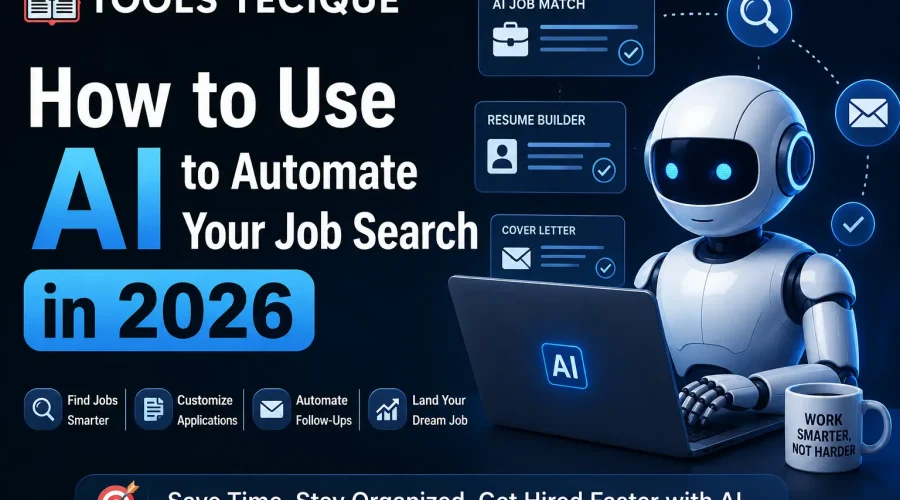
AI can meaningfully speed up a job search by helping tailor your resume to each specific job posting, drafting personalized cover letters, identifying relevant keywords that applicant tracking systems scan for, and even helping prepare for interviews through practice question generation. It works best as a drafting and research assistant, not a fully automated replacement for genuine networking and personal judgment in your applications.
Job searching has always been a part- and precision-numbers-game, and AI tools have quietly become useful for both sides of that equation. The trick is knowing where AI genuinely saves time versus where it can quietly undermine your application if used carelessly.
Menurut LinkedIn’s workforce research, a growing share of job seekers report using AI tools somewhere in their job search process, most commonly for resume tailoring and application drafting, reflecting how mainstream these tools have become in the hiring process.
Where AI Actually Helps in a Job Search
AI is most useful for tailoring your resume language to match a specific job posting, drafting a first version of a cover letter you then personalize, identifying keywords applicant tracking systems look for, and generating practice interview questions specific to a role. It is least reliable for fully automated mass applications, which often produce generic results that perform worse than targeted ones.
The distinction that matters is between AI as a drafting tool you refine versus AI as a replacement for your own judgment about which roles and companies to actually pursue.
From experience: A marketing professional laid off after eight years at the same company was applying to dozens of roles weekly with a generic resume and seeing almost no response. We used AI specifically to tailor her resume’s language to match each job posting’s specific terminology and requirements, while she retained full control over which achievements and numbers to highlight. Her interview request rate increased noticeably within the first month, not because AI wrote anything fundamentally new, but because the tailoring process that used to take her 45 minutes per application dropped to about 10 minutes, letting her apply to more roles with the same quality bar.
AI Job Search Tasks Compared by Reliability
| Task | AI Reliability | Human Review Needed |
|---|---|---|
| Resume keyword tailoring | Tinggi | Light review |
| Cover letter first draft | Sedang | Significant personalization |
| Interview practice questions | Tinggi | Practice your own answers |
| Fully automated mass applications | Low | Not recommended |
Poin pentingnya: Hiring managers and recruiters increasingly notice generic, obviously AI-generated applications. The tools work best when they speed up your own genuine effort, not when they replace it entirely.
How to Use AI Effectively in Your Job Search
- Feed AI the specific job posting alongside your resume to get genuinely tailored keyword and phrasing suggestions.
- Use AI-drafted cover letters as a starting point, then personalize specific details, tone, and genuine interest before sending.
- Generate role-specific interview practice questions, then actually rehearse your answers rather than reading AI-generated responses cold.
- Avoid fully automated application tools that submit generic applications at scale without genuine tailoring per role.
From experience: A recent computer science graduate used a fully automated AI application tool that submitted his resume to over 200 postings without any individual tailoring and received almost no responses despite strong technical qualifications. Switching to a slower, more deliberate process where AI helped tailor each of a much smaller batch of 20 applications specifically to each posting produced significantly more interview requests than the mass approach had generated across ten times as many applications.
Common Mistakes When Using AI for Job Applications
- Submitting obviously AI-generated cover letters without personalization, which experienced recruiters can often identify.
- Letting AI fabricate or exaggerate experience on your resume, which creates serious risk if discovered during interviews or background checks.
- Over-relying on fully automated mass application tools at the expense of genuine targeting and networking.
Pertanyaan yang Sering Diajukan
Q: Can recruiters tell if a cover letter was written by AI?
A: Experienced recruiters often notice generic, overly formulaic AI-generated cover letters that lack specific, personal details, which is why personalizing AI drafts with genuine, specific details matters for making a strong impression.
Q: Is it dishonest to use AI to help write my resume?
A: Using AI to help phrase and organize your genuine experience is generally considered a legitimate drafting tool, similar to using a template, as long as the underlying information remains accurate and truthful.
Q: Can AI help me find job openings, not just apply to them?
A: Yes, AI tools can help summarize and filter job postings based on your criteria, though verifying postings directly on company career pages remains a good practice to confirm current accuracy and legitimacy.
Q: Should I disclose that I used AI in my job application?
A: This is generally not required or expected, similar to not disclosing use of a spell-checker or resume template, as long as the content itself accurately reflects your genuine experience and qualifications.
Q: Does using AI application tools guarantee more interviews?
A: No, AI tools can improve efficiency and tailor quality, but genuine qualifications, targeted applications, and networking remain the primary drivers of interview success, not the tool itself.
Explore More AI Guides
ToolsTecique covers practical AI applications for everyday tasks in 2026. Our guide on the best AI chatbots compared can help you choose the right tool for drafting resumes, cover letters, and interview practice.
