










PA Turnpike Toll Calculator
All-Electronic Tolling (AET) Architecture: The Modern Cashless Pennsylvania Turnpike
The Pennsylvania Turnpike (officially designated as the Pennsylvania Turnpike Commission or PTC system) represents one of the most critical commercial freight arteries and passenger transit corridors in the United States. Spanning more than 550 miles across the Commonwealth of Pennsylvania, this historic toll highway connects the Midwestern industrial heartland with the Eastern Seaboard, carrying hundreds of thousands of motor vehicles daily across rugged Appalachian mountain passes, urban metropolitan rings, and interstate agricultural plains. In October 2021, the Pennsylvania Turnpike completed its historic transition to full All-Electronic Tolling (AET), permanently closing all physical toll booths, eliminating traditional toll collectors, and removing the requirement for vehicles to slow down or stop at toll plazas.
Under the All-Electronic Tolling framework, toll transactions are recorded instantaneously at highway cruising speeds (up to 70 mph) through state-of-the-art overhead toll gantries equipped with multi-sensor vehicle detection apparatus. Utilizing a comprehensive PA turnpike toll calculator allows motorists, fleet logistics dispatchers, and seasonal travelers to calculate exact travel expenses before departing, evaluate the dramatic cost variances between electronic transponder systems and mail billing, and optimize corporate budgets against escalating Act 44 toll schedules. Whether navigating the East-West Mainline (I-76, I-276, and I-95) from the Ohio state line to the New Jersey Delaware River Bridge, or traversing the mountainous Northeast Extension (I-476) from Mid-County to Scranton, pre-trip computational planning eliminates unexpected invoice surcharges and ensures seamless transit.
Every vehicle entering the turnpike is processed through one of two primary billing pathways: E-ZPass electronic transponder deduction or Toll By Plate photographic license plate invoicing. Because the financial disparity between these two methods is precisely calibrated at approximately a 100% markup (with Toll By Plate costing roughly double the E-ZPass rate), drivers who fail to verify their toll payment apparatus prior to departure incur substantial financial penalties. The technical architecture relies on automated Radio-Frequency Identification (RFID) antennas communicating with windshield transponders in microseconds, cross-referenced with automated license plate readers (ALPR) capable of optical character recognition in extreme weather conditions.
Total Turnpike System Miles
Mainline I-76/276/95, Northeast Extension I-476, and Western Expressway expansions
E-ZPass Rate Discount
Direct savings relative to standard Toll By Plate mailed paper invoicing
Passenger Base Rate / Mile
Standard Class 1 E-ZPass mileage charge under the latest Act 44 tariff schedule
Active Gantry Interchanges
Full access interchanges across western, central, and eastern Pennsylvania
Vehicle AVC Classes
Axle and height classification tiers ranging from passenger cars to multi-axle freight
Open Road Tolling Speed
Uninterrupted highway speed processing eliminating congestion and idle fuel burn
E-ZPass vs. Toll By Plate: Understanding the 50% Savings Economics
The single most influential factor governing your total travel cost on the Pennsylvania Turnpike is your chosen payment medium. The Pennsylvania Turnpike Commission maintains a statutory pricing policy engineered specifically to incentivize automated electronic transponder adoption while shifting the operational costs of manual debt collection, optical scanning, postage, and debt recovery onto non-transponder motorists. Consequently, drivers traveling with an active E-ZPass transponder pay the lowest published toll rates, saving an average of 50% across every mile traveled compared to those billed through Toll By Plate.
When an E-ZPass-equipped vehicle passes beneath a turnpike gantry, the transponder mounted behind the rearview mirror emits an encrypted radio signal that registers against the transponder serial number linked to your pre-funded prepaid account. The calculated toll is automatically debited in real time, requiring zero administrative paperwork. In stark contrast, when a vehicle without an E-ZPass transponder passes the same gantry, high-resolution optical cameras capture front and rear digital images of the vehicle’s license plate. The system automatically queries state motor vehicle registries (PennDOT or out-of-state DMVs), matches the registration with the vehicle owner’s legal mailing address, generates a paper statement, and mails a billing invoice within 30 to 40 days.
The Financial Cost of Delay: Toll By Plate Surcharges
Toll By Plate is not merely a payment method; it is a premium deferred-billing service. For standard passenger cars, a cross-state voyage from the Ohio border to the Delaware River Bridge costs approximately $53.20 using PA E-ZPass, compared to over $107.90 via Toll By Plate. For daily commuters or logistics fleets, operating without an E-ZPass results in thousands of dollars in unnecessary annual expenditure.
Furthermore, the Pennsylvania Turnpike recognizes two tiers of electronic transponder accounts:
- Pennsylvania E-ZPass (PTC-Issued): Accounts opened directly through the Pennsylvania Turnpike Commission receive the absolute lowest published toll tariffs, specialized commuter discount eligibility, and direct account synchronization via the PA Toll Pay mobile application.
- Out-of-State E-ZPass (Non-PTC Agencies): Transponders issued by member agencies of the regional E-ZPass Interagency Group (such as the New York MTA, New Jersey E-ZPass, Ohio Turnpike, or Maryland MDTA) are fully interoperable on the PA Turnpike. While out-of-state accounts receive substantial discounts over Toll By Plate, small regional tariff differentials may apply depending on interagency reciprocity agreements.
Automated Vehicle Classification (AVC): Axle Counts & Height Thresholds
Unlike turnpike systems that classify vehicles strictly by total gross vehicle weight (GVW), the Pennsylvania Turnpike utilizes an advanced Automated Vehicle Classification (AVC) system based on physical geometry—specifically, the total number of axles touching the pavement and, for two-axle vehicles, the physical height of the vehicle over the front axle. Knowing your exact vehicle classification is essential when using the PA turnpike toll calculator, as commercial and multi-axle freight rates scale dramatically as multiples of the baseline passenger vehicle rate.
The turnpike categorizes all highway traffic into standardized classes ranging from Class 1 through Class 7+:
| Vehicle Class | Classification Profile | Axle Count | Height Specification | Rate Multiplier | Typical Representative Vehicles |
|---|---|---|---|---|---|
| Class 1 (Class L) | Low Passenger Vehicle | 2 Axles | 7 feet, 6 inches or lower | 1.00x (Baseline) | Sedans, Coupes, SUVs, Minivans, Pickup Trucks, Motorcycles |
| Class 1H (Class H) | High Passenger Vehicle | 2 Axles | Exceeding 7 feet, 6 inches | 1.45x Multiplier | Tall Cargo Vans, Conversion Vans, Pickups with High Campers/Racks |
| Class 2 | Medium Duty Commercial | 2 Axles | Commercial configuration / High | 1.65x Multiplier | Step Vans, Box Trucks, Dual-Rear-Wheel Commercial Pickups |
| Class 3 | 3-Axle Combinations | 3 Axles | Any vehicle height | 2.15x Multiplier | Passenger Car + 1-Axle Trailer/Boat, 3-Axle Single Unit Trucks, Small RVs |
| Class 4 | 4-Axle Heavy Transport | 4 Axles | Any vehicle height | 2.80x Multiplier | Car + 2-Axle Tandem Travel Trailer, 4-Axle Dump Trucks, 3-Axle Bus + Trailer |
| Class 5 | 5-Axle Commercial Freight | 5 Axles | Standard commercial height | 3.85x Multiplier | Standard 18-Wheeler Semi-Tractor Trailers, Heavy Tanker Trucks |
| Class 6 | 6-Axle Heavy Combinations | 6 Axles | Commercial transport | 4.85x Multiplier | Tri-Axle Trailers, Lowboy Equipment Haulers, Multi-Axle Log Trucks |
| Class 7+ | Oversize & Specialized Heavy | 7 or More Axles | Specialized transport | 6.20x+ Multiplier | Heavy Industrial Crane Carriers, Multi-Trailer Combinations |
The 7-foot-6-inch height threshold is evaluated automatically by laser light curtains and infrared profiling scanners installed overhead at each gantry. Motorists traveling with high-profile rooftop cargo boxes, bicycles, or recreational kayaks mounted on roof racks must recognize that if the cargo fixture breaks the 7’6″ optical plane above the front axle, the automated sensor system may reclassify the vehicle from Class 1 to Class 1H for that specific segment.
Mainline (I-76 / I-276 / I-95) & Northeast Extension (I-476) Route Geography
The Pennsylvania Turnpike system is composed of two primary toll highways interconnected at the Mid-County Interchange (Norristown, Exit 333 / Exit A20), alongside several western expressway bypasses. Accurately navigating your trip requires understanding how mileage markers and exit numbers correspond to entry and exit gantries across both corridors.
The Mainline Turnpike (East-West Trans-Pennsylvania Corridor)
The Mainline stretches approximately 360 miles across the state, originating at Milepost 0 at the Ohio state border (where the Ohio Turnpike seamlessly transitions into the PA Turnpike Gateway Toll Plaza) and terminating at Milepost 360 at the Delaware River Turnpike Toll Bridge connecting directly into the New Jersey Turnpike. Key regional sectors include:
- Western Pennsylvania Sector (Milepost 0 to 75): Encompasses New Castle (Exit 10), Beaver Valley (Exit 13), Cranberry (Exit 28 connecting to I-79), Warrendale (Exit 30), Allegheny Valley (Exit 48), Pittsburgh / Monroeville (Exit 57 connecting to I-376), and New Stanton (Exit 75). At New Stanton, Interstate 70 merges onto the turnpike, running concurrently eastward through the Allegheny Mountains.
- Central Mountain Corridor (Milepost 75 to 226): Traverses some of the most rugged terrain in the Appalachian range, passing Donegal (Exit 91), Somerset (Exit 110), Bedford (Exit 146 connecting to I-99), and Breezewood (Exit 161). At Breezewood, I-70 exits southward toward Baltimore and Washington D.C., while I-76 continues eastward through the Tuscarora Mountain Tunnel, Kittatinny Mountain Tunnel, and Blue Mountain Tunnel toward Carlisle (Exit 226) and Harrisburg.
- Susquehanna Valley & Eastern Sector (Milepost 236 to 360): Connects Gettysburg Pike (Exit 236), Harrisburg West (Exit 242 connecting to I-83), Harrisburg East (Exit 247 connecting to Hershey), Lebanon-Lancaster (Exit 266), Reading (Exit 286), Morgantown (Exit 298), Downingtown (Exit 312), and Valley Forge / King of Prussia (Exit 326). East of Valley Forge, the highway designation transitions to I-276, serving the northern Philadelphia suburbs before intersecting the Delaware River Bridge gantry at Exit 43.
The Northeast Extension (I-476 North-South Pocono Corridor)
Branching northward from the Mainline at Mid-County (Exit A20 in Montgomery County), the Northeast Extension runs 110 miles due north through the Lehigh Valley and Pocono Mountains to its northern terminus at Clarks Summit (Exit A131) just north of Scranton, where it merges into Interstate 81. Major intermediate access points include Lansdale (Exit A31), Quakertown (Exit A44), Lehigh Valley / Allentown (Exit A56 connecting to US 22 and I-78), Mahoning Valley (Exit A74), Pocono (Exit A95 connecting to I-80), Wilkes-Barre (Exit A105), and Wyoming Valley (Exit A115). Our PA turnpike toll calculator features seamless cross-system routing, enabling travelers to calculate combined tolls from any Mainline origin to any Northeast Extension destination with zero manual arithmetic.
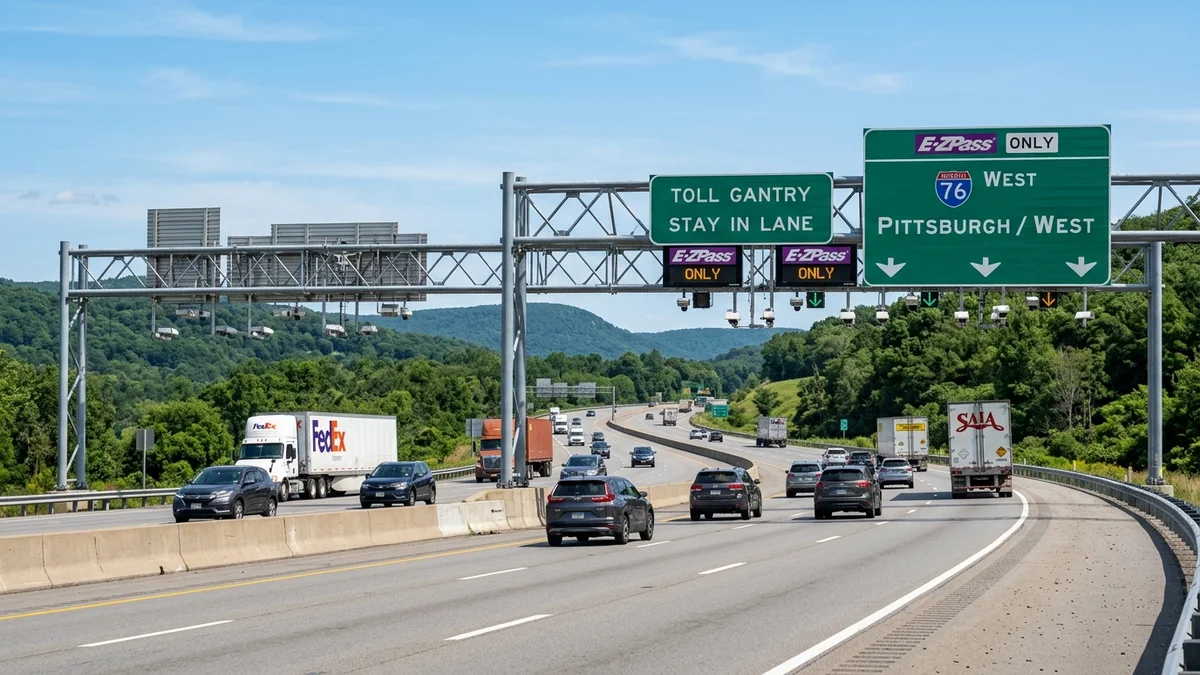
Open Road Tolling (ORT) Modernization: Gantries & Act 44 Rate Mandates
To understand why Pennsylvania Turnpike toll rates increase systematically each January, motorists must examine the dual statutory forces driving commission finance: the multi-billion-dollar Open Road Tolling capital improvement program and the legislative mandates of Pennsylvania Act 44 of 2007 (as amended by Act 89 of 2013).
Under Act 44, the Pennsylvania Turnpike Commission was legislatively mandated to provide substantial annual funding allocations—initially $450 million annually—to the Pennsylvania Department of Transportation (PennDOT) to subsidize non-turnpike transit operations, mass transit systems across Philadelphia (SEPTA) and Pittsburgh (PRT), and statewide bridge repairs. To service the resulting bond debt load, the PTC implemented planned annual toll adjustments averaging 3% to 6% every January. While legislative reforms have reduced the direct annual transfer obligation to $50 million, decades of accumulated capital debt necessitate steady, predictable annual rate schedules through at least 2050.
Open Road Tolling (ORT) Architecture: What Changes for Motorists?
The ongoing deployment of Open Road Tolling moves electronic collection gantries from historic entrance/exit slip ramps directly onto the main travel lanes between interchanges. Rather than calculating tolls strictly on a closed ticket matrix, the turnpike charges a flat segment base rate combined with a uniform per-mile fee ($0.073/mi for Class 1 E-ZPass in 2026), creating complete equity across all travel segments.
For motorists, the benefits of ORT are substantial:
- Elimination of Bottlenecks: Removing toll plaza canopies and lane dividers completely eliminates the dangerous merging conflicts that historically plagued holiday travelers at high-volume bottlenecks like Valley Forge, New Stanton, and Gateway.
- Reduced Carbon Footprint: Eliminating deceleration and subsequent acceleration cycles saves passenger cars and commercial vehicles millions of gallons of diesel and gasoline annually, reducing roadside greenhouse gas emissions.
- Lower Administrative Overhead: Operating overhead steel truss gantries equipped with remote diagnostics reduces structural maintenance costs compared to preserving aging concrete toll booth islands and underground utility tunnels.
Commercial Fleet Operations, Freight Budgets & Multi-Axle Surcharges
For commercial motor carriers, freight dispatchers, and independent owner-operators, turnpike toll expenditures represent one of the largest single operating costs alongside diesel fuel and tractor insurance. A standard Class 5 five-axle tractor-trailer (80,000 lbs GVW) traveling east-west across Pennsylvania pays approximately $205 to $215 using E-ZPass, compared to over $420 via Toll By Plate for a single one-way trip. For trucking companies running dedicated weekly logistics runs between Chicago, Pittsburgh, and New York/New Jersey ports, operating with optimized electronic toll accounts directly determines fleet operating margins.
Commercial carriers must structure their toll budgeting around three core operational parameters:
- E-ZPass Commercial Volume Discounts: Commercial fleets operating with Pennsylvania post-paid commercial E-ZPass accounts qualify for progressive monthly volume discount rebates based on aggregate toll expenditures. Fleet accounts spending between $1,000 and $5,000 monthly receive automated statement credits, with higher tiers available for enterprise freight carriers.
- Permitted Oversize / Overweight (OS/OW) Shipments: Vehicles exceeding 80,000 pounds gross weight, 8 feet 6 inches in width, or 13 feet 6 inches in height must obtain specialized engineering permits from the PTC prior to entering turnpike ramps. Surcharges scale with structural axle loading to compensate for accelerated pavement and bridge deck fatigue.
- Alternative Route Optimization: Logistics dispatchers frequently compare turnpike toll costs against alternative non-tolled corridors, such as Interstate 80 across northern Pennsylvania or Interstate 70/68 through West Virginia and Maryland. While I-80 features zero tolls, the Pennsylvania Turnpike offers lower grades through mountain tunnels (avoiding steep summits), reduced elevation changes, faster winter snow clearance, and direct arterial connectivity into Greater Philadelphia and New Jersey distribution hubs.
Toll By Plate Billing Lifecycles: Invoices, Deadlines & Dispute Workflows
For drivers who travel the turnpike without an active E-ZPass transponder, understanding the Toll By Plate billing lifecycle is critical for avoiding aggressive administrative late fees, collections referrals, and potential vehicle registration suspension under Pennsylvania motor vehicle law.
The standard Toll By Plate collection sequence follows a strictly timed statutory calendar:
| Billing Stage | Timeline Post-Travel | Document Issued | Fee Additions | Action Required |
|---|---|---|---|---|
| Initial Billing | Within 30 Days | Toll By Plate Invoice | None (Standard 2x Rate) | Pay in full within 30 days online, via PA Toll Pay app, or by mail |
| Past Due Notice | 30 Days After Initial | First Past-Due Notice | +$5.00 Administrative Fee | Remit payment immediately to halt escalation to collections |
| Collections Notice | 60 Days After Initial | Final Demand / Collections | +$25.00 Collection Fee | Account referred to third-party collection agencies (credit impact) |
| PennDOT Suspension | Unpaid ≥ $250 / 4+ Tolls | Notice of Registration Suspension | Court costs & registration reinstatement fees | Vehicle registration legally suspended; police impoundment authorized |
Under Pennsylvania Act 112, drivers who accumulate $250 or more in unpaid tolls and administrative fees, or who have four or more distinct delinquent toll invoices, are subject to mandatory motor vehicle registration suspension by PennDOT. Furthermore, out-of-state motorists face reciprocal debt enforcement agreements between Pennsylvania, Delaware, New York, and other neighboring states, enabling out-of-state DMVs to suspend vehicle registrations on behalf of the Pennsylvania Turnpike Commission.
If you receive an erroneous Toll By Plate invoice—such as a vehicle you recently sold, a misidentified license plate digit on an optical scan, or a trip taken while your valid E-ZPass transponder was mounted in the windshield—you can file an electronic dispute directly through the PA Turnpike website or the PA Toll Pay app. For transponder read failures, providing your active E-ZPass account number typically reduces the billed amount down from the high Toll By Plate rate to the discounted E-ZPass rate.
Strategic Commuter Optimization: Travel Times, Mountain Tunnels & Planning
Daily commuters navigating the suburban Philadelphia Mainline (Valley Forge to Bensalem) or traveling between the Lehigh Valley and Philadelphia along the Northeast Extension can achieve massive financial and time savings through strategic planning. Incorporating our PA turnpike toll calculator into your weekly routine enables rapid evaluation of the following commuter benefits:
The Mountain Tunnel Advantage
The central Pennsylvania Mainline features four major historic mountain tunnels: the Allegheny Mountain Tunnel (Somerset County), the Tuscarora Mountain Tunnel (Huntingdon/Franklin Counties), the Kittatinny Mountain Tunnel, and the Blue Mountain Tunnel. On the Northeast Extension, travelers traverse the Lehigh Tunnel beneath Blue Mountain. Unlike regional secondary highways (such as US 30 or US 22) that climb steep 9% mountain grades with sharp switchbacks and heavy winter icing, the turnpike tunnels bore directly through the mountain ridges at modest highway gradients. For winter commuters and commercial fleets, the reliability, reduced engine wear, and safety of turnpike tunnels vastly outweigh the toll investment.
Pre-Trip Checklists for Pennsylvania Turnpike Motorists
- Mount Your Transponder Correctly: Always mount your E-ZPass transponder on the upper inside windshield, at least one inch below the roofline and behind the rearview mirror. Handheld transponders or devices placed on the dashboard frequently fail to read, triggering unwanted Toll By Plate invoices.
- Keep Your License Plate Registered: Ensure all current license plates and vehicle descriptions are registered on your online E-ZPass account profile. If a transponder battery fails, the system uses license plate matching (V-Tolls) to debit your account at the discounted rate rather than generating a mailed invoice.
- Monitor E-ZPass Account Balance: Maintain an active credit card backup on your E-ZPass account with automated auto-replenishment enabled. A depleted account turns transponders inactive, leaving you subject to full Toll By Plate rates and violation fees.
- Utilize the Commuter Savings Planner: Use Tab 2 of our interactive calculator above to project your weekly, monthly, and annual toll expenditure. Commuters driving 5 days per week save over $1,200 to $2,500 annually simply by maintaining an active E-ZPass account.
By leveraging our official 2026 PA turnpike toll calculator, drivers across Pennsylvania and regional interstate corridors can forecast accurate toll costs, take advantage of the 50% E-ZPass discount, and enjoy smooth, uninterrupted transit across the Commonwealth.
Frequently Asked Questions
E-ZPass uses a small electronic transponder mounted on your windshield that automatically deducts tolls from a prepaid account at heavily discounted rates. Toll By Plate is a video tolling system that photographs your license plate at highway speeds and mails an invoice to the vehicle registered owner at approximately double the cost of E-ZPass.
Pennsylvania Turnpike tolls are mileage-based and calculated using legislative Act 44 debt-service schedules. Tolls combine a base rate per mile (currently $0.073 per mile for Class 1 passenger vehicles with E-ZPass) plus fixed interchange segment fees, scaled by vehicle weight, height, and axle classification.
PA Turnpike drivers save approximately 50% on every toll transaction by using a valid E-ZPass transponder. For example, traveling the entire 359-mile Mainline from Gateway to Delaware River Bridge costs approximately $34.50 with E-ZPass compared to nearly $70.00 via Toll By Plate.
Yes. The Pennsylvania Turnpike accepts all valid E-ZPass transponders issued by any member agency within the 19-state E-ZPass Interagency Group (such as New York, New Jersey, Ohio, Maryland, Virginia, Massachusetts, and Illinois) and automatically grants the 50% discounted E-ZPass toll rate.
The PA Turnpike operates an entirely cashless Open Road Tolling (ORT) system. Overhead gantries equipped with RFID transponder readers, high-resolution cameras, and 3D LiDAR sensors capture vehicle data at full highway speeds without requiring drivers to slow down or stop at toll plazas.
If you do not have an active E-ZPass transponder, overhead cameras photograph your vehicle license plate. The Pennsylvania Turnpike Commission accesses state DMV motor vehicle records and mails a Toll By Plate invoice to your home address within 2 to 3 weeks.
The PA Turnpike classifies vehicles from Class 1 through Class 8 based on gross vehicle weight (GVW), axle count, and vehicle height. Standard passenger cars, SUVs, and minivans under 7,000 lbs are Class 1. Vehicles over 7.5 feet in height qualify as Class 1H, while commercial multi-axle freight trucks pay progressive weight-tier multipliers ranging from 2.85x up to 9.25x the passenger rate.
Yes. The Pennsylvania Turnpike Commission provides commercial volume discount programs for commercial fleet accounts whose monthly tolls exceed specific expenditure thresholds, as well as post-paid commercial billing options.
Cross-system trips connecting the Mainline (I-76 / I-276) and Northeast Extension (I-476) transition seamlessly through Mid-County Interchange (Exit 333 / NE MP 20). The calculator sums the entry-to-Mid-County mileage on the first route with the Mid-County-to-exit mileage on the connecting route to produce the exact continuous toll.
You can dispute a Toll By Plate invoice online at paturnpike.com or through the official PA Toll Pay mobile app. Common disputes include vehicles sold prior to the toll date, misread license plates, or an active E-ZPass transponder that failed to read. If you provide your active E-ZPass account number, the commission can re-bill the invoice at the discounted E-ZPass rate.