










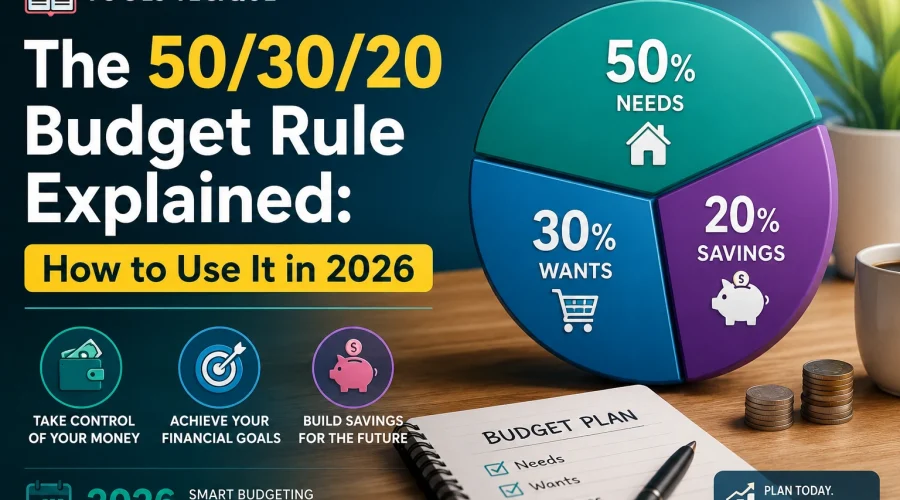
Most budgets fail not because people lack discipline, but because they are too complicated to maintain. Tracking dozens of spending categories is not sustainable for most working adults. The 50/30/20 rule solves this with just three buckets and a clear percentage for each.
Only 33% of Americans have a written financial plan or budget, according to the Schwab Modern Wealth Survey. The 50/30/20 rule is not a perfect budget, but it is one almost anyone can start and stick with. Starting is what matters most.
What Is the 50/30/20 Rule?
The 50/30/20 budget rule divides your monthly after-tax income into three categories: 50% for needs (housing, utilities, groceries, transportation, minimum debt payments), 30% for wants (dining out, entertainment, travel, hobbies), and 20% for savings and extra debt repayment (emergency fund, retirement, paying down credit cards). Popularised by Senator Elizabeth Warren in All Your Worth (2005), it remains widely recommended as the simplest effective personal finance framework for beginners and busy professionals.
Important: Use after-tax income the amount deposited to your account not your gross salary. 401(k) contributions deducted automatically still count toward your 20% savings category.
What Counts as Needs, Wants, and Savings?
Needs are expenses you cannot avoid without significant consequences: rent or mortgage, utilities, groceries, minimum loan payments, health insurance, and basic transportation. Wants are choices that improve lifestyle but are not essential: streaming services, restaurants, gym memberships, travel, and clothing beyond basics. Savings includes emergency fund contributions, retirement accounts, extra debt payments above minimums, and investments. The hardest items to categorise are borderline expenses like a car payment for a non-essential vehicle.
| Category | Target | Examples |
|---|---|---|
| Needs | 50% | Rent, groceries, utilities, insurance, minimum debt payments, basic transport |
| Wants | 30% | Dining out, streaming, gym, travel, hobbies, subscriptions |
| Savings and Debt | 20% | Emergency fund, 401(k)/IRA, extra debt payments, investments |
Example Budgets at Three Income Levels
Applying the 50/30/20 rule to a $5,000 monthly after-tax income produces: $2,500 for needs, $1,500 for wants, and $1,000 for savings and debt. At $3,000/month: $1,500 needs, $900 wants, $600 savings. At $8,000/month: $4,000 needs, $2,400 wants, and $1,600 savings. The median US household income is $80,610 annually (US Census Bureau, 2026), approximately $5,200 monthly after-tax for a single earner, producing targets of $2,600 needs, $1,560 wants, and $1,040 for savings.
| Monthly Take-Home | 50% Needs | 30% Wants | 20% Savings |
|---|---|---|---|
| $3,000 | $1,500 | $900 | $600 |
| $5,000 | $2,500 | $1,500 | $1,000 |
| $8,000 | $4,000 | $2,400 | $1,600 |
| $12,000 | $6,000 | $3,600 | $2,400 |
Calculate your own split using the free Budget Calculator at ToolsTecique.
From experience: A 29-year-old marketing coordinator earning $58,000 gross ($4,100 take-home) was convinced she could not save anything. When we ran her numbers through the 50/30/20 framework, her needs were at 62% driven by $1,400/month rent, which was 34% of take-home alone. She found a roommate, cut rent to $850, and freed $550/month. Within 8 months she had a $4,000 emergency fund for the first time in her life.
When the 50/30/20 Rule Needs Adjusting
The 50/30/20 rule does not work as-is for everyone. Low-income earners in high-cost cities often find housing alone exceeds 50% of take-home pay. Heavy debt loads may require a temporary 50/10/40 split cutting wants sharply and pushing 40% toward debt elimination. People with no consumer debt and strong savings might shift to 50/20/30, expanding wants after the savings target is met. The framework is a starting point adjust the percentages to fit your actual situation.
| Situation | Recommended Adjustment |
|---|---|
| High-cost city, rent above 30% of income | 55/25/20: accept higher needs temporarily |
| Heavy credit card or student loan debt | 50/10/40 cut wants to attack debt |
| No consumer debt, strong emergency fund | 50/30/20 as written |
| Approaching retirement within 10 years | 40/20/40 maximizes savings rate |
From experience: A freelance designer with a monthly income between $3,500 and $7,000 struggled with fixed-percentage budgeting. We adapted by using her lowest reliable income ($3,500) as the base. Needs were budgeted against that floor. Every dollar above $3,500 went 50% to savings and 50% to wants. This variable-income version finally gave her structure without the stress of lower-income months.
Frequently Asked Questions
Q: Does the 50/30/20 rule work for low incomes?
A: On very low incomes, housing and basics often consume well above 50% of take-home pay. A 70/10/20 or even 80/0/20 split is more realistic. The priority is maintaining some savings rate, even if small. Use the Budget Calculator at ToolsTecique to find a split that works for your actual income.
Q: Should my 401(k) count in the 20% savings category?
A: Yes. Any retirement contribution counts toward your 20% target. Capturing the full employer match should be the first priority within the 20% bucket before any other savings goal.
Q: What is the difference between zero-based budgeting and 50/30/20?
A: The 50/30/20 rule groups spending into three broad categories, simple to maintain. Zero-based budgeting assigns every dollar to a specific purpose, which is more precise but requires more time monthly. Use 50/30/20 to start, then shift to zero-based if you want granular control or are in aggressive debt payoff mode.
Q: How do I handle irregular income with the 50/30/20 rule?
A: Budget based on your lowest reliable monthly income. Any income above that floor should be split intentionally: 50% to savings, 30% to wants, 20% flexible. This ensures baseline obligations are always covered. The Debt Repayment Calculator at ToolsTecique can help you model variable scenarios.
Q: Is 20% savings realistic?
A: For many Americans, 20% is aspirational. Bankrate’s 2026 survey shows 56% cannot cover a $1,000 emergency, suggesting most people save far less. The goal is directional; if you save 3% today, getting to 8% is a major win. Increase by 1% to 2% every few months as habits solidify.
Start Your Budget Today
Use the free Budget Calculator at ToolsTecique to calculate your three targets instantly. Then run your debt through the Debt Repayment Calculator to see how quickly you can clear debt by redirecting money from wants to savings.
