










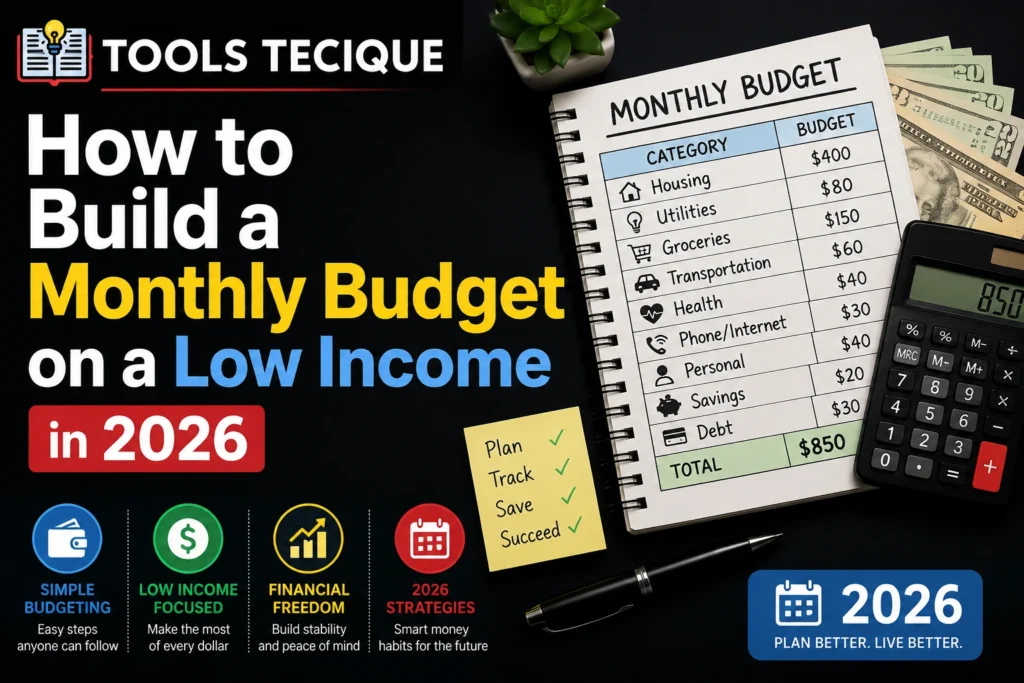

If you are counting dollars until your next paycheck, this guide is written for you. Budgeting on a low income is not about willpower; it is about making a plan that covers what you absolutely need, keeps debt from compounding, and gradually creates a small buffer.
According to Bankrate’s 2026 survey, 56% of Americans cannot cover a $1,000 emergency from savings. The Consumer Financial Protection Bureau reports that millions of households operate without any financial cushion. A budget does not fix low income, but it gives you clarity and control, which are the first two ingredients of any financial improvement.
Step 1: Know Your Real Monthly Income
Before budgeting, calculate your exact monthly after-tax income from all sources: primary job take-home pay (not gross salary), part-time or gig work, government benefits, child support received, and any other regular deposits. For variable income, use your lowest month from the past 3 months as your baseline. Budgeting against a reliable floor protects you from over-committing in better income months. Do not include unreliable one-off income in your monthly plan treat it as a bonus when it arrives.
- Take-home pay after taxes (check your pay stub not gross salary)
- Freelance or gig income use your slowest recent month conservatively
- Government benefits: SNAP, housing assistance, disability, child tax credit
- Child support or alimony received
Step 2: Prioritise Expenses in the Right Order
When income is limited, expense priority order is more important than any percentage rule. The correct order is: (1) housing to prevent eviction or foreclosure, (2) utilities needed for work or safety, (3) groceries, (4) transportation needed for work, (5) minimum debt payments to protect credit, (6) childcare needed to maintain employment, (7) critical medications. Everything else comes after these are covered. Skipping or delaying any of the first five typically creates larger and more expensive problems.
| Priority | Expense | Why First |
|---|---|---|
| 1 | Housing (rent/mortgage) | Eviction or foreclosure creates far bigger problems |
| 2 | Utilities (electricity, heat, water) | Required for safety and often remote work |
| 3 | Groceries | Buy staples not convenience foods |
| 4 | Work transportation | Losing a job costs far more than any transport bill |
| 5 | Minimum debt payments | Missed payments trigger penalties and credit damage |
| 6 | Childcare/dependent care | Required to maintain employment |
| 7 | Critical medications | Health expenses affecting ability to work |
A Realistic $2,500 Monthly Budget Example
A person earning $2,500 per month after taxes can cover necessities and save a small amount with strict prioritisation. Example: rent $800, utilities $150, groceries $250, transportation $200, phone $50, minimum debt payments $200 = $1,650 in fixed needs (66%). Remaining $850 split as: $100 emergency savings (4%), $150 extra debt payment (6%), $600 discretionary (24%). Even $100/month builds $1,200 annually enough to cover most small unexpected expenses without going into debt.
| Expense | Monthly | % of Income |
|---|---|---|
| Rent (shared or modest) | $800 | 32% |
| Utilities | $150 | 6% |
| Groceries | $250 | 10% |
| Transportation | $200 | 8% |
| Phone | $50 | 2% |
| Minimum debt payments | $200 | 8% |
| Total Fixed Needs | $1,650 | 66% |
| Emergency savings | $100 | 4% |
| Extra debt payment | $150 | 6% |
| Discretionary | $600 | 24% |
From experience: A warehouse worker earning $2,300/month with $8,400 in credit card debt and no savings had a core problem: $975 rent was 42% of income, leaving almost nothing else and forcing him to use his credit card for shortfalls. We found him a roommate, cut rent to $600, and redirected $375/month to debt. He paid off the entire $8,400 in 26 months without earning a single extra dollar. The budget was the tool cheaper housing was the lever.
Building an Emergency Fund When Money Is Tight
On a low income, the emergency fund goal is not 3 to 6 months of expenses immediately that target is paralyzing. Start with a $500 mini emergency fund as your first milestone. $500 covers most car repairs, medical co-pays, and minor appliance replacements. Saving $50 to $100 per month reaches $500 in 5 to 10 months. Once $500 is saved, shift focus to debt repayment, then build toward a $1,000 fund as the second milestone before returning to larger savings goals.
- Cancel unused subscriptions average American spends $219/month on underused subscriptions (C+R Research, 2026)
- Switch to a cheaper phone plan prepaid options from $15 to $30/month
- Apply for SNAP, LIHEAP, or local food banks to reduce grocery and utility costs
- Sell unused items one clear-out can generate $200 to $500
- Automate savings even $25/week auto-transferred removes the temptation to spend it
Debt Repayment on a Tight Budget
When income is limited, the most important debt move is making minimum payments on all accounts without fail missed payments trigger penalty fees and rate increases that compound the problem. Beyond minimums, target your highest-interest debt first (usually credit cards at the current average of 24.59% APR, Federal Reserve 2026). Even $50 extra per month on a $3,000 credit card balance at 24.59% reduces your payoff timeline from 11 years to 4.5 years and saves over $3,100 in interest.
Use the Debt Repayment Calculator at ToolsTecique to see exactly how much extra payment you need to reach your payoff goals.
From experience: A single mother working two part-time jobs asked whether to save or pay debt first. She had $1,200 in credit card debt at 26% APR and $0 in savings. The right sequence: save $300 as a tiny emergency buffer first (6 weeks of hustle), then attack the $1,200 debt with every spare dollar. Once the card was cleared, she redirected the former minimum payment into savings. Within 14 months she had both a zero card balance and a $1,800 emergency fund. The sequence mattered as much as the amounts.
Frequently Asked Questions
Q: How do I budget when I can barely cover my bills?
A: List every bill and its due date, then map them against your income pay dates. Prioritise in order: housing, utilities, food, transportation, minimum debt payments. If income does not cover all of these, explore assistance programs (SNAP, LIHEAP, local food banks, utility assistance) before cutting any essential. The CFPB has a free financial assistance finder at consumerfinance.gov.
Q: Is saving $50 a month even worth it?
A: Yes. $50/month adds $600/year to your buffer. In 10 months you have $500 the key threshold separating financially vulnerable households from those with a basic cushion. Over 5 years at $50/month in a 4.5% APY account, you accumulate $3,357 enough to cover most emergencies without going into debt.
Q: Should I save or pay off debt first on a low income?
A: Save a small $300 to $500 buffer first, then attack high-interest debt aggressively. Without any buffer, every unexpected expense goes back onto a credit card negating your progress. Use the Debt Repayment Calculator to plan your payoff timeline.
Q: What government programs can help supplement my budget?
A: SNAP (food), LIHEAP (utilities), Medicaid, CHIP, Section 8 housing vouchers, Earned Income Tax Credit (EITC), and local community action agencies. Visit benefits.gov to find programs you qualify for in your state.
Q: How do I handle unexpected expenses with no savings?
A: First, negotiate a payment plan with the provider most medical offices and utilities offer them. Check local nonprofits for emergency assistance. If credit is necessary, use the lowest-interest option available never payday loans, which average 400% APR. Build toward that $500 emergency fund as your primary near-term goal.
Build Your Budget Today
Start with the free Budget Calculator at ToolsTecique. Enter your monthly take-home income and see your spending targets in seconds. Then pair it with the Debt Repayment Calculator to build a debt payoff plan that works alongside your budget.